
Diecast Devon may earn a small referral fee at no cost to the reader from these links.
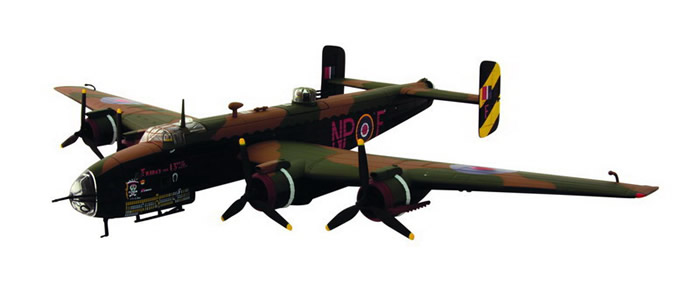
First flown from RAF Bicester on 25 October 1939, the Handley Page Halifax entered service with 35 Squadron in November 1940. The Halifax I and II aircraft were powered by Rolls-Royce Merlin engines and the Halifax III was powered by Bristol Hercules engines. Apart from its role as a heavy bomber, the Halifax III and later versions also served in Coastal Command and in paratrooping and glider towing roles. Yorkshire was the home of 4 and 6 Groups Bomber Command and three Halifax Squadrons were based at Elvington, 77 Squadron, and two French Air Force Squadrons, 346 (Guyenne) and 347 (Tunisie). The Yorkshire Air Museum’s Halifax reconstruction is based on a section of the fuselage of Halifax II, HR792, which carried out an emergency landing on the Isle of Lewis in 1945. The wings came from Hastings, TG536, at RAF Catterick. The reconstruction is named ‘Friday the 13th’ in honour of Halifax, LV907, which survived 128 operations with 158 Squadron. It is the only surviving Halifax in the world.
| Manufacturer | Corgi |
|---|---|
| Model Range | Aviation Archive |
| Model Scale | 1:72 |
| Ltd Edition | 2001 |
| Release Date | Oct-08 |


